How Much Does an Aluminum Can Weigh a Complete Guide with Size and Alloy Details
How much does an aluminum can weigh? A typical 12-ounce soda can weighs about 15 grams.
This weight depends on the can’s size, alloy, and thickness. Most standard cans use 3104-H19 aluminum alloy with a thin wall around 0.005 inches.
Aluminum cans are very light, which makes them easy to transport and recycle. Manufacturers have reduced their weight by about 70% over the past 40 years. That means less energy is needed for making and shipping them, which saves money and resources.
Remember that can weights vary by brand and design. Smaller or taller cans might weigh less or more than average. Checking the can’s label or product specs can help figure out its exact weight.
Key Takeaways
- A standard 12-ounce aluminum can weighs about 15 grams (0.53 ounces).
- Aluminum cans use thin walls around 0.005 inches thick for lightness.
- Cans have become 70% lighter in 40 years to save energy and costs.
- Can alloys like 3104-H19 balance strength and weight for durability.
- Smaller or specialty cans may weigh more or less than the standard.
- Knowing a can’s weight helps calculate recycling value and material use.
What Is the Average Weight of a Standard Aluminum Can?
A standard 12-ounce aluminum can typically weighs between 13 and 15 grams. This weight equals about 0.46 to 0.53 ounces, roughly half an ounce per empty can. Most soda cans, especially those made from the common 3104-H19 alloy, fall within this range.
Different types of beverage cans vary in weight based on their volume and design. Smaller energy drink cans of 8.4 ounces usually weigh 10 to 12 grams.
Larger cans, like a 16-ounce tall beer can, can weigh 18 to 21 grams. Even bigger single-serve cans up to 24 ounces commonly weigh 25 to 30 grams.
Thicker aluminum alloys or specialty designs also affect weight. Beer cans often have thicker walls, pushing their average weight to roughly 16 to 18 grams.
Craft or embossed cans sometimes weigh above 18 grams due to added metal. These differences come from the need for durability and brand design choices.
Weighing the cans accurately matters if you collect scrap or recycle at home. Thirty to thirty-two empty 12-ounce cans will weigh about one pound.
Using a kitchen scale can help you check batches to estimate your total aluminum weight. Avoid mixing different can types during weighing since their weights can differ significantly.
How Do Aluminum Can Sizes Affect Their Weight?
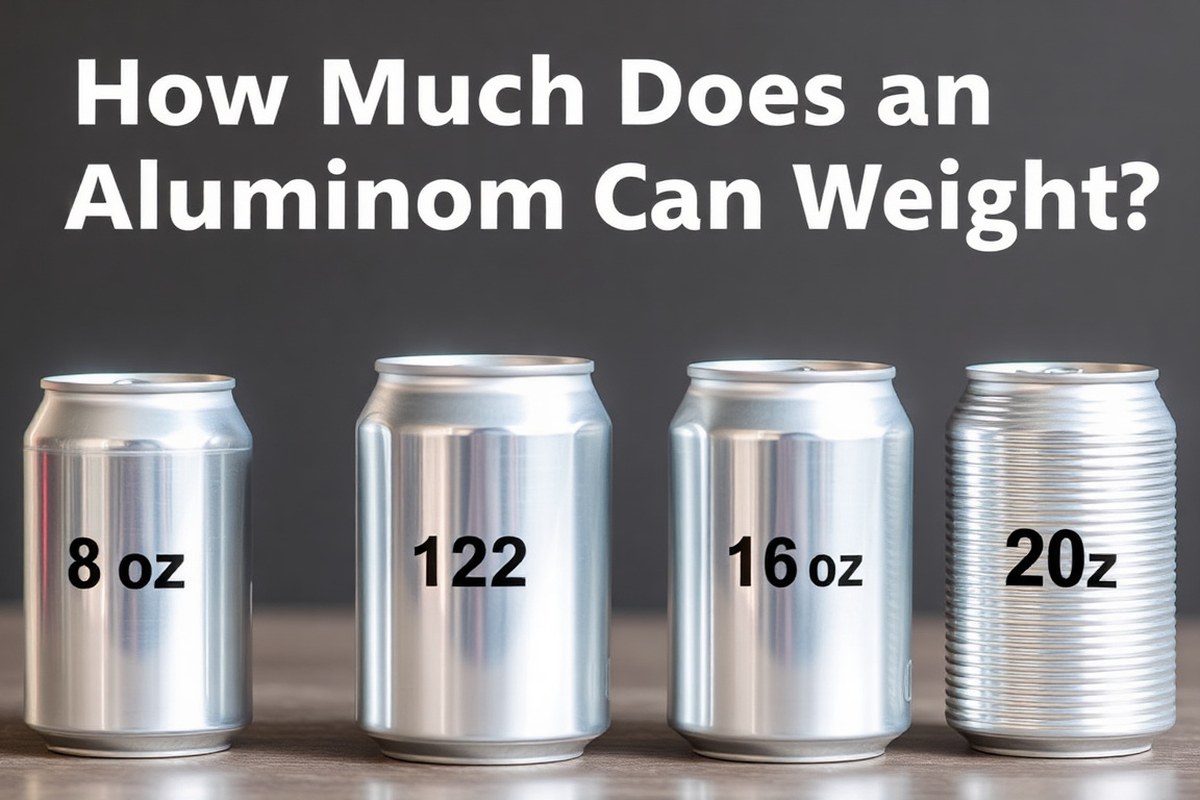
Aluminum cans weigh more as their size grows because they hold more volume. Larger cans use more aluminum in the body and bottom. They also usually have thicker walls to keep them sturdy and safe during shipping.
The table below shows common can sizes with their volume and typical weights. These numbers come from the usual alloys and manufacturing standards. While small design tweaks can alter weights slightly, bigger cans almost always weigh more.
| Can Size (Fluid Ounces) | Volume (mL) | Typical Weight (grams) |
|---|---|---|
| 8 oz | 237 mL | 13, 15 grams |
| 12 oz | 355 mL | 14, 16 grams |
| 16 oz | 473 mL | 20, 25 grams |
| 24 oz | 710 mL | 30, 40 grams |
Using more aluminum gives larger cans enough strength to hold more liquid without denting. The body is often made from 3104 alloy with wall thicknesses about 0.25, 0.33 mm.
Ends use a different alloy, 5182, which affects the overall can weight too. Recycling centers value heavier cans more since they have more metal content.
Weigh cans before recycling to get accurate scrap value since size changes weight significantly.
If you try to guess can weight based just on size, remember manufacturing methods can slightly shift weights. Advanced factories squeeze out extra weight savings by refining how they shape the aluminum. But volume stays the biggest weight factor across typical can sizes.
Which Aluminum Alloys Are Used in Can Manufacturing?
Modern aluminum cans mainly use alloys 3104-H19 and 5182-H48. These alloys offer a good balance of weight, strength, and durability. Different alloys are chosen for can bodies and ends because each part needs unique properties.
Common Aluminum Alloys in Can Bodies
The 3104-H19 alloy is the standard choice for can bodies. It contains aluminum mixed with about 1% manganese and small amounts of magnesium and silicon. This alloy shapes well into cans.
It stays lightweight too. That helps keep the whole can’s weight low.
This alloy in H19 temper means it is hardened partially by cold working. The temper improves strength without adding too much weight.
A 12-ounce can body with 3104-H19 weighs about 9 to 10 grams. This is before adding the can end.
Alloys Used for Can Ends
Can ends often use the 5182-H48 alloy, which differs from 3104-H19. This alloy includes about 4% magnesium, giving it higher strength and excellent resistance to internal pressure. It helps the can end hold shape under carbonation pressure.
The higher magnesium content makes 5182-H48 denser and slightly heavier. But can ends are thinner.
This tradeoff ensures the can end is tough without boosting total weight too much. Typical can ends weigh about 3 to 4 grams.
How Alloy Choice Influences Can Weight
The density for these alloys ranges from about 2.7 to 2.8 grams per cubic centimeter. Choosing an alloy with higher density or that requires thicker sections adds to the can’s weight.
Alloys like 3104-H19 help keep the can light. They also make shaping by machines easy.
Newer alloys cut can weights by 2 to 3 grams. This change happened since the 1970s.
Thinner walls with stronger alloys cut metal usage but keep durability. You’ll notice modern cans feel lighter but still sturdy.
Why Different Alloys for Bodies and Ends?
The can body mainly needs to be lightweight and easy to form in manufacturing. Alloy 3104-H19 fits here because it balances formability with strength. The thinner body walls help reduce metal use and recycling costs.
The can end must resist dents and pressure from carbonation. That’s why 5182-H48 is used, it can take more stress without cracking. This alloy’s added thickness and strength ensure it seals tightly and lasts through transport.
Key Alloy Properties Affecting Weight and Durability
- 3104-H19: Good formability, medium strength, low density
- 5182-H48: Higher strength, more magnesium, tougher ends
- Density: Around 2.7, 2.8 g/cm³, varies by alloy mix
- Thickness: Thinner for bodies, thicker for ends improves performance
- Temper: Cold working (H19, H48) adds strength without more weight
These factors influence how much metal each can needs. That changes the weight slightly between brands and designs. Alloy and temper choices balance lightness, strength, and cost during production.
How to Calculate Aluminum Can Weight from Dimensions and Density?
How to Calculate Aluminum Can Weight from Dimensions and Density?
You can find an aluminum can’s weight by measuring its size. Measure the wall thickness too. Then multiply the volume by aluminum’s density.
This method uses simple geometry and looks at material density, which varies slightly by alloy. Measuring carefully and choosing the right density number gives you a reliable estimate.
Measuring Can Dimensions Accurately
Measure the can’s height and diameter to calculate its volume. Use a caliper or ruler for these measurements. Next, measure the wall thickness, which is usually under one millimeter.
This thickness matters because it shows the volume of aluminum itself, not the hollow space inside. Measure in millimeters for precision. You should do this at several points around the can to get an average thickness.
- Measure the can’s height from base to top edge in centimeters.
- Measure the can’s diameter across the middle in centimeters.
- Measure the wall thickness in millimeters using calipers.
- Repeat thickness measurements around the can and average them.
- Convert wall thickness from millimeters to centimeters for volume use.
Density Values for Common Aluminum Alloys
Density of aluminum varies slightly by alloy type, usually given in kg/m³. Common soda can alloys have densities around 2,700 kg/m³. For example, AA3104 and AA3004 have densities near this number.
Using the right density affects your weight estimate. Selecting 2,700 kg/m³ (or 2.7 g/cm³) often works well for cans. This value reflects the solid aluminum, ignoring minor fillers or coatings.
Step-by-Step Weight Calculation Example
Calculate how much aluminum material a 12 oz can contains. Suppose the can has a diameter of 6.5 cm, height 12.5 cm, and thickness 0.25 mm (0.025 cm). Start by calculating the can’s total volume and subtracting the hollow inside.
- Convert wall thickness to centimeters: 0.25 mm = 0.025 cm.
- Calculate outer radius: 6.5 cm ÷ 2 = 3.25 cm.
- Calculate inner radius: 3.25 cm − 0.025 cm = 3.225 cm.
- Calculate outer volume: π × (3.25 cm)² × 12.5 cm ≈ 414.69 cm³.
- Calculate inner volume: π × (3.225 cm)² × 12.5 cm ≈ 408.38 cm³.
- Calculate aluminum volume: 414.69 cm³ − 408.38 cm³ = 6.31 cm³.
- Multiply by density: 6.31 cm³ × 2.7 g/cm³ ≈ 17.04 g.
This estimate of 17.04 grams is a bit higher than typical commercial cans. That difference is due to wall thickness; many cans use less than 0.25 mm. Adjust thickness for your can to get closer to averages of 12.8 to 14.1 grams depending on region.
Why Does Aluminum Can Weight Vary Between Brands and Designs?
The weight of aluminum cans varies due to different design and manufacturing choices. Brands use various techniques to balance strength, appearance, and cost. Thicker aluminum means a heavier can, but this raises material costs and shipment weight.
Can bodies undergo deep drawing and ironing, which thins the side walls to about 0.097 millimeters. Some brands opt for thicker walls to avoid dents during transport. Vintage cans usually weigh more since older tech used thicker aluminum before advances in metal forming.
Coatings inside cans prevent corrosion and preserve taste, adding extra weight. Shrink sleeves and printed labels on the outside also contribute weight, though usually less than 0.1 grams per can. These coatings need removal during recycling.
They change how scrap gets processed. You must consider them carefully.
- Thickness of aluminum walls varies by brand and can type.
- Deep drawing creates ultra-thin walls, lowering weight but needing advanced tech.
- Coatings and linings protect contents but add small extra weight.
- Sleeves and printed labels add slight weight differences between designs.
- Vintage cans tend to be heavier due to thicker walls and simpler manufacturing.
Using recycled aluminum affects density and weight slightly because scrap materials vary. Most cans have about 70% recycled content.
But small changes in alloy mix or impurity levels shift the mass. Processing plants sort cans by weight to optimize revenue; heavier cans bring more money.
Check local recycling rules to know if coatings or sleeves need removal before recycling cans.
Brand choices and manufacturing steps directly cause aluminum can weight differences. Knowing the thickness and coatings helps. It shows why some cans weigh more.
Even if the sizes look the same. This knowledge helps with accurate sorting and calculating recycling payments.
How Many Aluminum Cans Make One Pound or One Kilogram?
About 30 to 34 standard 12-ounce aluminum cans add up to one pound. That means each can weighs roughly 13 to 15 grams. For one kilogram or 2.2 pounds, expect 65 to 75 cans, depending on their exact weight.
Smaller or larger cans change the cans-to-weight ratio. Mini cans weigh less, so you need more to hit a pound.
Larger cans weigh more, so fewer cans reach the same weight. Thickness and can design also influence weight, making precise counts tricky without a scale.
To estimate batch weight, count the cans first. Then use approximate ratios or weigh a sample batch. This helps you get a good estimate.
Weigh 50 to 100 crushed cans on your home scale. Divide the total weight by the can count.
Use this average weight for your whole batch. This approach gives a customized number close to reality.
| Number of 12-Ounce Cans | Approximate Aluminum Weight | Approximate Scrap Value at $0.50/Lb |
|---|---|---|
| 50 | About 0.7 lb (320 g) | About $0.35 |
| 100 | About 1.5 lb (680 g) | About $0.75 |
| 250 | About 3.7 lb (1.7 kg) | About $1.85 |
| 500 | About 7.4 lb (3.4 kg) | About $3.70 |
| 750 | About 11.0 lb (5.0 kg) | About $5.50 |
| 1,000 | About 14.7 lb (6.7 kg) | About $7.35 |
| 2,000 | About 29.4 lb (13.3 kg) | About $14.70 |
Use this table to find the aluminum weight for your cans. It lets you quickly estimate total weight. This works if you know how many cans you have.
Keep in mind, cans with different shapes or age may weigh slightly more or less. Counting by hand and multiplying can miss these little differences. So using a small sample is smarter for better accuracy.
What Is the Scrap Value of Aluminum Cans and How to Calculate It?
The current scrap price for aluminum cans is about $0.85 per pound. Prices usually move up and down during the year depending on demand and supply. Most scrap yards pay you based on the total weight of your cans in pounds.
To figure out your total payout, first weigh your aluminum cans. One pound equals around 34 empty 12-ounce cans. Multiply the total pounds by the current scrap price to get your earnings.
For example, if you have 10 pounds of cans and the price is $0.50 per pound, multiply 10 x 0.50 to get $5. This method works for different weights and prices. Just use your exact weight and the rate scrap yards list.
Keep your cans clean and dry to get the best scrap value. Dirt or paint lowers the price since scrap yards pay less for contaminated metal.
Flattening cans helps you fit more in your container. It does not change their weight or payout.
Sometimes scrap yards pay closer to $0.70 per pound when demand rises, especially in busy recycling months. They pay $0.10 per container returned.55 per pound, you’ll need about 182 pounds of cans to earn $100. That translates to almost 6,000 cans, so patience pays here.
You can guess your average price by watching local scrap yards or national price trackers online. Use a midrange number, like $0.50 per pound, to keep your expectations realistic. This avoids overestimating what your cans are worth today.
How to Weigh Aluminum Cans Accurately at Home or Small Scale?
Weighing aluminum cans accurately is key to getting the right value when recycling or selling. A good scale, clean cans, and careful measuring help you get precise numbers. Taking averages from several cans also keeps your results reliable.
Choosing the Right Scale for Can Weight
A digital kitchen scale or postal scale works well for weighing cans. Look for one that measures in grams or ounces with at least a 1-gram precision. Avoid bathroom scales since they’re less accurate for light items.
A scale with a flat platform and tare function makes weighing easier. The tare button resets the scale to zero when you place a container on it. This helps you weigh only the cans without container weight.
Preparing Cans Before Weighing
Rinse cans to remove leftover liquid or dirt. Dirty cans will add extra weight, messing up your measurements. Let the cans dry well since wet cans weigh more and throw off the totals.
Crush cans gently if you need to save space. But don’t deform them too much.
Flattened or torn cans can weigh less or get stuck on the scale. Group the same type of cans for each measurement.
Recording and Calculating Average Weights
Weigh cans in batches rather than individually for more accuracy. Weigh around 10 to 20 cans per batch if you collect many. Record the total weight and the number of cans to calculate the average.
To find the average weight, divide the batch weight by the can count. For example, if 15 cans weigh 180 grams total, one can weighs 12 grams on average. Keep a simple chart to track each batch’s weight and counts.
- Clear your scale’s platform and press tare to zero it.
- Rinse and dry a batch of 10 to 20 cans thoroughly.
- Place the cans evenly on the scale platform.
- Record the total weight shown on the scale.
- Count the exact number of cans weighed in the batch.
- Repeat for at least three batches for better accuracy.
- Calculate the average weight by dividing total weight by can count.
- Use the average weight to estimate total weight for larger collections.
Tip: Always weigh cans dry and empty. Wet or sticky cans give false results that shrink your payout.
| Batch Number | Number of Cans | Total Weight (grams) | Average Weight (grams) |
|---|---|---|---|
| 1 | 15 | 180 | 12 |
| 2 | 20 | 240 | 12 |
| 3 | 10 | 120 | 12 |
What Is the Environmental Impact of Aluminum Can Weight on Recycling?
Reducing the weight of aluminum cans greatly saves energy during production and recycling. Recycling aluminum uses only about 5% of the energy needed. Making new cans from raw ore takes much more energy.
This saves a lot when you recycle aluminum. That’s a 95% energy savings compared to starting fresh. Lighter cans require less material, cutting the energy required to produce and transport them.
Lightweighting keeps cans strong enough to hold pressure while using less aluminum. This means less energy to mine, smelt, and roll the metal. Every lighter can reduces carbon emissions linked to these steps.
Saving just a few grams per can adds up fast. Over millions of cans, you save tons of aluminum. Every small bit counts in recycling.
In recycling, lighter cans make sorting and processing more efficient. The aluminum can be melted down and reused endlessly without quality loss. This circular use cuts waste and pollution.
Recycling one aluminum can saves enough energy for three hours of TV. Aluminum recycles at nearly 100% efficiency. Clean, empty cans without liners or plastic keep recycling quality high.
Small leftover bits of other materials or liquids can ruin batches of recycled aluminum. That wastes energy and means more raw mining is needed. Sorting improvements and proper consumer recycling habits help keep the circular process strong.
Using recycled aluminum also lessens the impact of extracting new ore. Combining lightweighting with high recycling rates creates a sustainable loop. It lowers energy costs and reduces greenhouse gases in both production and transport.
Places with lower recycling access may waste more energy. Heavy cans cost more energy to transport. Transport costs can increase overall energy use.
On the other hand, ultra-light cans can be more prone to damage in shipping. Finding the right balance between lightness and durability works best for minimizing overall impact.
Step-by-Step Action Plan to Weigh and Sell Aluminum Cans
Follow these simple steps to weigh your aluminum cans accurately and maximize their scrap value.
- Before you start: Gather a basic kitchen scale that can measure in grams or ounces.
- Day 1: Collect a batch of clean, empty cans without lids or extra materials. This ensures consistent weight.
- Day 2: Weigh a single can to confirm your scale’s accuracy. It should read close to 13, 15 grams for a standard 12-ounce can.
- Week 1: Weigh a larger pile of cans and record the total weight. Use this number to estimate how many cans you have.
- Week 2: Check scrap aluminum prices at your local recycling center. You can also find prices online. Use this info to calculate your cans’ scrap value.
- After 2 weeks: Compare your total weight and expected payout regularly. Adjust how many cans you collect based on your goals.
- Ongoing: Keep cans clean and sorted by size if possible. Different sizes can affect weight and payout rate.
- Periodically: Review your weighing process to avoid adding extra weight from labels or lids.
Frequently Asked Questions
How Much Does an Empty Aluminum Can Weigh?
An empty standard aluminum can weighs about 15 grams or 0.53 ounces. This weight can slightly vary depending on the can’s design and brand.
Does a Full Aluminum Can Weigh Much More Than an Empty One?
Yes, a full 12-ounce can weighs roughly 370 grams or 13 ounces. The content adds most of the weight compared to the empty can itself.
Can the Weight of Aluminum Cans Indicate Their Thickness?
Yes, heavier cans usually have thicker walls, making them sturdier. Aluminum thickness affects weight and influences how much aluminum was used.
How Much Does a 24-ounce Aluminum Can Weigh Compared to a 12-ounce?
A 24-ounce aluminum can weighs about twice as much as a 12-ounce can. This is because it uses roughly double the aluminum to hold the extra volume.
Why Do Some Aluminum Cans Weigh Less Even If They Look the Same?
Cans weigh less if manufacturers reduce aluminum thickness to save material costs. Advances in design can lower weight without losing strength.
Key Points to Remember
Knowing an aluminum can’s weight helps with recycling. It shows how many cans make a pound. It also helps find the number for a kilogram.
Accurate weighing supports better payouts and more efficient recycling. Now, start weighing your cans to see what you can collect and sell today.