How Fast Is 80 Kilometers per Hour? Accurate Conversions & Real-World Comparisons
You might wonder how fast is 80 kilometers per hour in more familiar terms. Simply put, 80 kilometers per hour equals about 50 miles per hour.
This speed is faster than most city speed limits across the United States. It is slower than many highway speeds in different countries such as Germany or France.
Knowing this conversion helps when driving in different places or checking speed limits on signs. To convert, just multiply the kilometers per hour by 0.621371 for miles per hour. At 80 km/h, you’re covering roughly 1.33 kilometers every minute, which equals about 0.83 miles each minute.
This means you travel 1 kilometer in about 45 seconds or 1 mile in about 72 seconds. Understanding this speed helps plan trip times accurately and stay safe on roads with varying limits. It also gives a clearer idea of how fast you’re really going on unfamiliar roads.
Key Takeaways
- 80 kilometers per hour is approximately 49.71 miles per hour.
- Multiply kilometers per hour by 0.621371 to convert to miles per hour.
- At 80 km/h, you travel 1.33 kilometers every minute.
- It takes about 45 seconds to travel 1 kilometer at 80 km/h.
- This speed is common on rural roads and some suburban areas.
- Use handheld calculators or apps to quickly convert speed units.
How Fast Is 80 Kilometers per Hour in Miles per Hour?
80 kilometers per hour converts to about 49.71 miles per hour. You get this by multiplying 80 by 0.621371, the exact conversion factor from kilometers to miles. This makes 80 km/h roughly equal to 50 mph, a common reference point for speed.
To convert manually, divide the speed in kilometers per hour by 1.609344 or multiply it by 0.621371. For example, 80 km/h × 0.621371 equals 49.71 mph. Using a calculator helps keep your answer accurate, especially when handling decimals.
Speeds need conversion because different countries use either kilometers or miles per hour. This difference matters when reading road signs or checking speed limits abroad. Knowing how to convert helps you understand speeds clearly, no matter where you are.
Other Speed Units Equivalent to 80 Kilometers per Hour
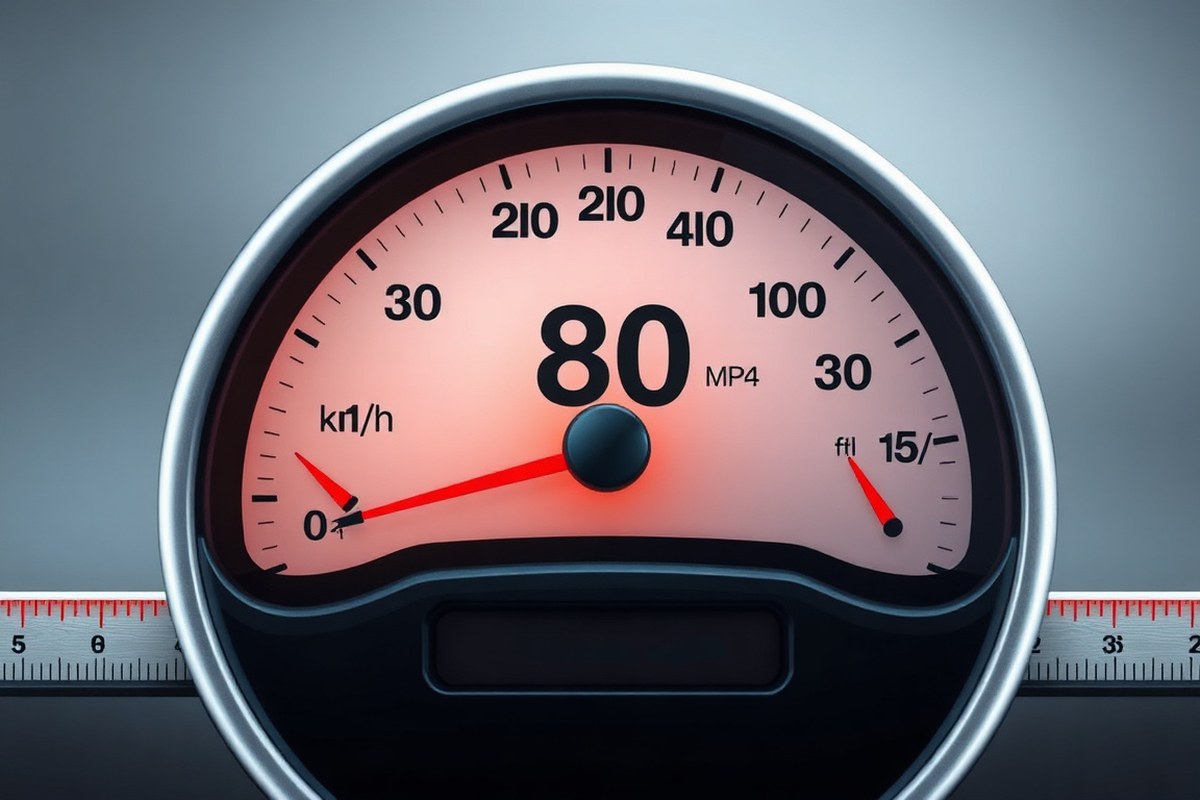
Speed conversions let you understand 80 kilometers per hour in other units. To convert kilometers per hour to meters per second, divide by 3.6. This gives the exact speed in m/s, which shows how far you travel in one second.
For feet per second, you multiply the meters per second value by 3.281. This converts metric distance to feet, a unit used more often in the United States. Knots measure speed in marine and aviation settings.
They come from converting kilometers per hour. You multiply by about 0.54 to get knots.54.
| Speed Unit | Equivalent of 80 km/h | How to Convert |
|---|---|---|
| Meters per second | 22.22 m/s | 80 ÷ 3.6 |
| Feet per second | 72.87 ft/s | (80 ÷ 3.6) × 3.281 |
| Knots | 43.2 knots | 80 × 0.54 |
These conversions help you picture and compare speed in different contexts. For example, 22.22 m/s is useful in physics or sports.
43.2 knots helps if you track boat or plane speed. Knowing the exact math makes it easier to switch units quickly.
To make these conversions yourself, use the formulas above with a calculator. The math is simple and only needs basic division or multiplication. Small errors can occur if you round numbers too soon.
Using rough conversion factors also causes mistakes. Be sure to use exact numbers for accuracy.
Use a calculator for these conversions to avoid simple math errors, especially in critical tasks.
How to Calculate Travel Time at 80 Km/h for Common Distances
Traveling 1 kilometer at 80 km/h takes 45 seconds. For bigger distances, multiply that time by the number of kilometers. You can also use a formula to find travel time for any distance at this speed.
Calculating Time for a Single Kilometer
At 80 kilometers per hour, covering 1 kilometer takes just 45 seconds. This is because you travel 80 kilometers in one hour, which equals 3600 seconds. Dividing 3600 seconds by 80 gives the time for one kilometer.
Knowing this simple fact helps you estimate short travel times quickly. For example, 45 seconds per kilometer keeps trips under tight timing easy to plan.
Scaling Time for Larger Distances
To find the time for longer distances, multiply the time per kilometer by that distance. For example, 5 kilometers at 80 km/h takes 5 times 45 seconds, or 225 seconds. That’s 3 minutes and 45 seconds.
Similarly, 10 kilometers take 7 minutes 30 seconds. Going 50 kilometers at this speed takes 37 minutes 30 seconds.
100 kilometers needs 1 hour 15 minutes. These examples show how travel time scales linearly with distance.
Using Formulas for Custom Distances
You can calculate travel time using the formula t = d ÷ v. Here, t means time in hours. Distance, d, is in kilometers.
Speed, v, is kilometers per hour. Just divide the distance by the speed to get time.
To convert time into minutes, multiply the result by 60. For example, traveling 12 kilometers at 80 km/h means t = 12 ÷ 80 = 0.15 hours. Multiply 0.15 by 60 to get 9 minutes.
Follow these steps to calculate your travel time accurately:
- Identify your distance in kilometers.
- Know your speed is 80 kilometers per hour.
- Divide the distance by 80 to get time in hours.
- Multiply the time in hours by 60 to convert to minutes.
- Multiply remaining decimal minutes by 60 to get seconds. Do this when needed.
- Combine hours, minutes, and seconds for total travel time.
How Does 80 Km/h Compare to Typical Speed Limits Worldwide?
80 km/h is a very common speed limit for rural roads in many countries. This speed fits well between faster highway limits and slower urban zones. Countries like Canada, France, and several others set 80 km/h as their standard outside city areas.
Urban speed limits are usually lower to keep people safe. They often set limits around 50 km/h or less. This helps to manage traffic and protect pedestrians.
Rural limits usually allow higher speeds due to clearer roads and fewer crossings. The 80 km/h limit balances safety with efficient travel on these less crowded routes.
| Country | 80 km/h Use | Common Urban Limit (km/h) | Common Rural Limit (km/h) |
|---|---|---|---|
| Canada | Default rural road limit | 50 | 80 |
| France | Default rural speed limit | 50 | 80 |
| United States | Rare, mostly rural state roads | 25-35 | 70-112 |
| Germany | Used on some rural roads | 50 | 80-100 (some roads) |
| Australia | Common on rural roads | 50-60 | 80-100 |
Using this table, you can see 80 km/h is typical outside cities in many places. City speed limits are lower for safety reasons, like more crosswalks and traffic lights. This difference affects how you should drive and plan your travel time.
Exact limits may change by state or road type. For example, the US does not use 80 km/h a lot. It usually sets rural speed limits between 70 and 112 km/h.
On the other hand, European countries often have a consistent 80 km/h rural limit. Knowing these differences helps you stay within the law and drive safely.
How Does 80 Km/h Compare to Human and Animal Speeds?
How Human Running Speeds Stack Up
The fastest recorded human sprint speed is about 27.8 mph (44.7 km/h). That’s much slower than 80 km/h. Elite athletes only maintain top speed briefly over short distances like 100 meters.
Running faster than 80 km/h is impossible for people. You would need more than twice the speed of the quickest sprinter. In everyday terms, 80 km/h is more than most cars can drive in city limits.
Fast Land Animals Near 80 Km/h
The cheetah is the fastest land mammal. It can run up to 60 to 70 mph. That’s about 97 to 113 km/h.
This is faster than 80 km/h, but only for short bursts under 30 seconds. Its body length and muscle structure aid in this quick acceleration.
Other fast animals like pronghorns can reach speeds up to 55 mph (88 km/h). They sustain high speeds longer than cheetahs but are not as quick in a brief sprint.
Animal Speed Relative to 80 Km/h
Some birds and sea animals can go over 80 km/h. The peregrine falcon can dive at 200 mph. That equals 320 km/h.
This is much faster, but diving speed is aided by gravity. The black marlin swims fast but exact speeds are unclear.
On land, 80 km/h is around the speed of a fast deer or greyhound running. It means driving at 80 km/h equals outrunning almost all humans and many common animals.
How to Compare Speeds Practically
To visualize 80 km/h, think of running around 22 meters every second. A cheetah covers roughly 16 body lengths per second. The comparison helps show why humans can’t nearly match that pace.
Try timing how long it takes you to walk or run 100 meters. Multiply your speed by time to learn your pace. Then picture doubling that to beat 80 km/h, which feels nearly impossible.
Common Speed Comparisons for Perspective
Here’s a quick list to put 80 km/h in context with other speeds:
- Typical human running top speed: 28 mph (45 km/h)
- Cheetah sprint speed: up to 70 mph (113 km/h)
- Pronghorn running speed: about 55 mph (88 km/h)
- Peregrine falcon dive speed: up to 200 mph (320 km/h)
- Greyhound running speed: around 40 mph (64 km/h)
- Average city driving speed: about 25 to 40 mph (40 to 65 km/h)
This list shows 80 km/h beats human and most dog speeds. But it’s slower than top mammals and birds.
Be aware that many animals only reach their top speeds for a few seconds. Comparing speeds needs context about duration and conditions.
Common Mistakes and Tips When Converting Speeds
Converting 80 kilometers per hour to miles per hour often leads to rounding errors. People usually use 1.6 as the conversion factor, which is close but not exact.
The exact number is 1 kilometer equals about 0.621371 miles. So 80 km/h equals roughly 49.71 mph.
Rounding 49.71 mph to 50 mph is fine for everyday use. You get problems if you round too early in your math. Using a rough factor like 0 also causes trouble.
Keep your numbers precise to avoid those errors.6, which creates bigger errors. These mistakes can matter if you need precise speeds for science or legal reasons.
- Use 0.621371 as the conversion factor for accuracy
- Keep at least two decimal places before rounding
- Use online calculators to double-check tricky conversions
- Check whether you’re converting km/h to mph or vice versa
- Write down your steps to avoid skipping or mixing numbers
Online tools like Google’s unit converter or calculator apps help avoid mistakes. They do the math instantly and keep decimals precise. These tools cost nothing and save time compared to doing manual conversions.
Knowing when to round depends on your needs. For a speedometer or casual reference, rounding to 50 mph works.
For detailed travel calculations or engineering, keep more decimal places. Always confirm your conversion matches the unit system you want.
Factors Affecting Travel Time at 80 Km/h Speeds
Traveling at 80 km/h can feel very different depending on road conditions. Wet or icy roads reduce traction, making it unsafe to maintain this speed. You should slow down and allow more space to stop, especially in rain or fog.
Traffic congestion often means you can’t keep a steady 80 km/h pace. Stop-and-go traffic lowers your average speed and increases travel time. Try leaving earlier or using apps to avoid traffic jams when possible.
Your vehicle’s condition also affects how well it travels at 80 km/h. Worn tires or brakes reduce control and safety. Make sure your tires have proper air pressure and enough tread to grip the road well.
Bad weather often makes you drive slower than 80 km/h. It can be hard to keep that speed in rain or snow. You should slow down even if you want to go faster.
Rain lowers visibility and road grip; snow or ice require much slower speeds. Check the weather forecast and plan extra time if conditions look tough.
Heavy traffic causes frequent braking and acceleration, which wears out your vehicle faster. It also raises fuel consumption compared to smooth driving at a constant 80 km/h. Keeping your vehicle tuned helps handle these conditions better.
Some vehicles handle 80 km/h easier than others. A small car might feel steady.
But a heavy truck could take longer to stop. Load weight matters too; avoid carrying extra weight if you want safer, efficient travel.
During dry, clear conditions on smooth roads, maintaining 80 km/h is easier. You will use less fuel and reach your destination on time. Drive with steady acceleration and avoid sudden movements to keep control and save fuel.
Road surfaces also play a role. Rough, uneven, or gravel roads can slow you down below 80 km/h.
You may feel vibrations and less stability. So reduce speed and focus on smooth steering to stay safe.
Safety Considerations When Traveling at 80 Kilometers per Hour
Traveling at 80 kilometers per hour requires careful attention to safety. Your stopping distance at this speed combines your reaction distance and braking distance. For example, if your reaction time is 1.5 seconds, your vehicle travels about 33 meters before you start braking.
At 80 km/h, your total stopping distance can reach around 57 meters on a dry road. Wet or icy roads can double or triple this distance. That’s why adjusting your speed based on weather and road conditions is critical.
Legal speed limits often set 80 km/h as the maximum on rural roads or certain highways. Always follow posted speed limits when driving. Slow down near heavy traffic or sharp curves.
Stay cautious in places with poor visibility. Reducing speed to 60 km/h or lower can greatly improve control and safety in these spots.
- Keep a safe following distance of at least 3 seconds behind the car ahead.
- Scan the road constantly for hazards such as pedestrians or animals.
- Use headlights in low light or rain to improve visibility.
- Check tire tread and pressure regularly to maintain grip.
- Avoid sudden maneuvers; gentle braking and steering reduce skidding risk.
- Plan extra time to reach your destination safely, avoiding rush and pressure.
Reducing speed before turns, intersections, and crowded areas lowers crash risk. Slow down early if the road is slippery or if you feel uneasy. At 80 km/h, sharp turns taken too fast can cause loss of control within seconds.
Never rely on braking alone. Start slowing down early to match road and traffic conditions.
Defensive driving habits help you react better. At 80 km/h, you cover 22 meters each second.
That means distractions or drowsiness costing even one second delay your response greatly. Regular breaks on long trips keep your reaction times sharp and your drive safe.
Tools and Calculators for Converting and Understanding 80 Km/h
You can convert 80 km/h to other units online. Use apps to calculate travel times too. These tools make it simple and fast.
These tools are quick to use and can save time when you need exact numbers. Some also help plan trips and compare speeds in different units.
Top Online Conversion Websites
Several websites offer free, fast conversion between km/h and miles per hour or other units. Most let you enter 80 km/h directly and see instant results. These sites usually handle multiple units beyond speed, like distance and time.
Sites like UnitConverters.net and ConvertUnits.com are popular. They provide clear inputs and results on one page without extra sign-ups. The conversion uses a fixed rate: 1 km/h equals about 0.621 miles per hour.
- UnitConverters.net: simple km/h to mph conversion
- ConvertUnits.com: conversion among speed, distance, and time
- RapidTables: fast input and copy-ready results
- CalculatorSoup: options for rounding and unit details
- OnlineConversion.com: covers rare and common units
Put 80 in the “km/h” box on a converter. Then click convert to see mph or other speeds.
This shows how fast 80 km/h really is. These tools work on any web browser and are free.
Mobile Apps for Speed and Travel Time
Smartphone apps make converting 80 km/h and estimating travel times easy on the go. Many free apps let you plug in speed and distance to get the trip duration. Maps apps often show expected travel time based on your current speed or speed limits.
Apps like Speed Converter handle many units easily. They also let you save speeds you use often. This helps you convert speeds quickly later.
GPS apps like Google Maps can show travel times. They use your set speeds or custom routes. This helps plan your trips better.
- Speed Converter app: converts km/h to mph, knots, and more
- Speed Calculator app: calculates travel time for any distance
- Google Maps: estimate travel time by adjusting routes
- Units Plus Converter: multi-unit tool with speed focus
- Trip Calculator apps: input speed and distance for exact time
Most apps are free with optional upgrades costing under $5. They work offline once downloaded, so you can use them anywhere.
Tips for Accurate Use of Calculators
Enter precise numbers for speed, distance, and units to get right answers. Avoid typing just approximate speeds like “about 80” because decimals matter. Check units carefully before converting.
Travel time calculators expect consistent units: kilometers for distance if you use km/h for speed. Mixing miles with km/h will give wrong results unless you convert first. Also, these tools assume steady speed without stops or traffic.
For example, type 80 km/h and 100 kilometers if you want travel time. The calculator divides distance by speed for time. Round final answers sensibly, using minutes or hours as fits the trip length.
Step-by-Step Action Plan for Understanding and Using 80 Km/h Speeds
Use this plan to get comfortable with converting, comparing, and safely using 80 km/h speeds. Each step builds your practical knowledge.
You learn to measure travel times. This helps you calculate speeds in daily life.
- Before you start: Memorize that 80 km/h equals about 50 mph. You’ll use this basic fact often and know if your calculations feel right.
- Day 1: Try converting speeds you see on road signs or apps into miles per hour. Check your result with an online calculator to confirm accuracy.
- Day 2: Calculate travel times for 10, 25, and 50 miles. Use 80 km/h as your speed. This shows how long each trip takes. Write times down and compare estimates to actual trips or maps.
- Week 1: Note typical speed limits around you in km/h and mph. See if 80 km/h feels fast, slow, or normal in those contexts.
- Week 2: Try measuring speed in meters per second. Also, use feet per second for 80 km/h. This helps you understand different speed units. Use these in practical examples, like sports or walking speeds.
- After 3 weeks: Use a speed conversion app or tool during drives or bike rides. Watch for speedometer accuracy and improve your instinct for 80 km/h.
- After 1 month: Go over safety tips for traveling at 80 km/h. Consider weather and road type effects. These tips improve your travel safety. Adjust your travel times experimentally to see differences.
- Ongoing: Avoid common mistakes such as mixing miles and meters or rounding too soon. Double-check conversions whenever possible for better precision.
Frequently Asked Questions
How Long Does It Take to Travel 80 Kilometers at 80 Km/h?
It takes exactly one hour to travel 80 kilometers at this speed. Speed means distance divided by time.
80 kilometers ÷ 80 km/h = 1 hour. This shows it takes one hour to cover 80 kilometers at that speed.
Is 80 Kilometers per Hour a Safe Speed on Rural Roads?
80 km/h can be safe on many rural roads with good conditions. Check local speed limits and road quality before deciding to drive this fast.
How Much Fuel Is Used Driving at 80 Km/h Compared to Higher Speeds?
Driving at 80 km/h generally uses less fuel than speeding over 100 km/h. Lower speeds reduce air resistance, which helps improve fuel efficiency.
Can a Bike Reach 80 Kilometers per Hour?
Most regular bikes can’t reach 80 km/h on flat ground. Racing bikes or bicycles going downhill with a strong push might get close to this speed.
How Does 80 Km/h Affect Stopping Distance Compared to Slower Speeds?
Stopping distance at 80 km/h is longer than at slower speeds. The faster you go, the more time and space you need to stop safely.
Before You Go
You now know that 80 kilometers per hour equals about 50 miles per hour. You also see how this speed works in daily travel. This helps you plan your trips better.
Start by checking your local speed signs and timing short trips at this speed. This hands-on approach will help you feel confident about speed conversions and travel times fast.